01
OPERATIONAL INTEL BRIEFING
From rules on paper
to systems that keep your licence to operate.
Core belief: All three must be right — People, Systems, Project Execution.
Independent governance and systems architect wiring the Governance–Process–Systems (GPS) spine so board decisions hold in production. Consultants provide a diagnosis; I provide the digital infrastructure to ensure your business executes, scales, and stays compliant—automatically.
SIGNAL BLOCK // WHY WE EXIST
Correct by Design, Not After Failure
Rapid domain adaptation and GPS spine orchestration for regulators, Treasuries, PE‑backed operators, and quota‑driven enterprises where 60–76% of programmes fail — and you can’t afford to be in that statistic.
[PROJECT_INDEX_LOAD]
NODE_SCOPE_02
PROJECT SCOPE SCAFFOLD
Gold Standard Body of Work
A selective index of high-stakes architectures, registries, and operational models. Explore the scope and systemic breakthroughs without exposing proprietary client operations.
OPERATING RANGE
Over three decades I’ve moved from mainframe and client–server delivery, through a long investing era, into digital‑twin and public‑value platforms — more than 20,000 hours of deep work bridging systems and capital.
Mainframe · UNIX · Ingres
Desktop · Client-Server
Oracle · DB2 · SQL Server
COM+ · Stored Procedures · Migration Logic
Packaged Platforms · CustomerOne
Cloud · GCP · MySQL
AI-Augmented · Trading · Algorithmic Systems
[GPS_PILLAR_VERIFY]
NODE_SPINE_03
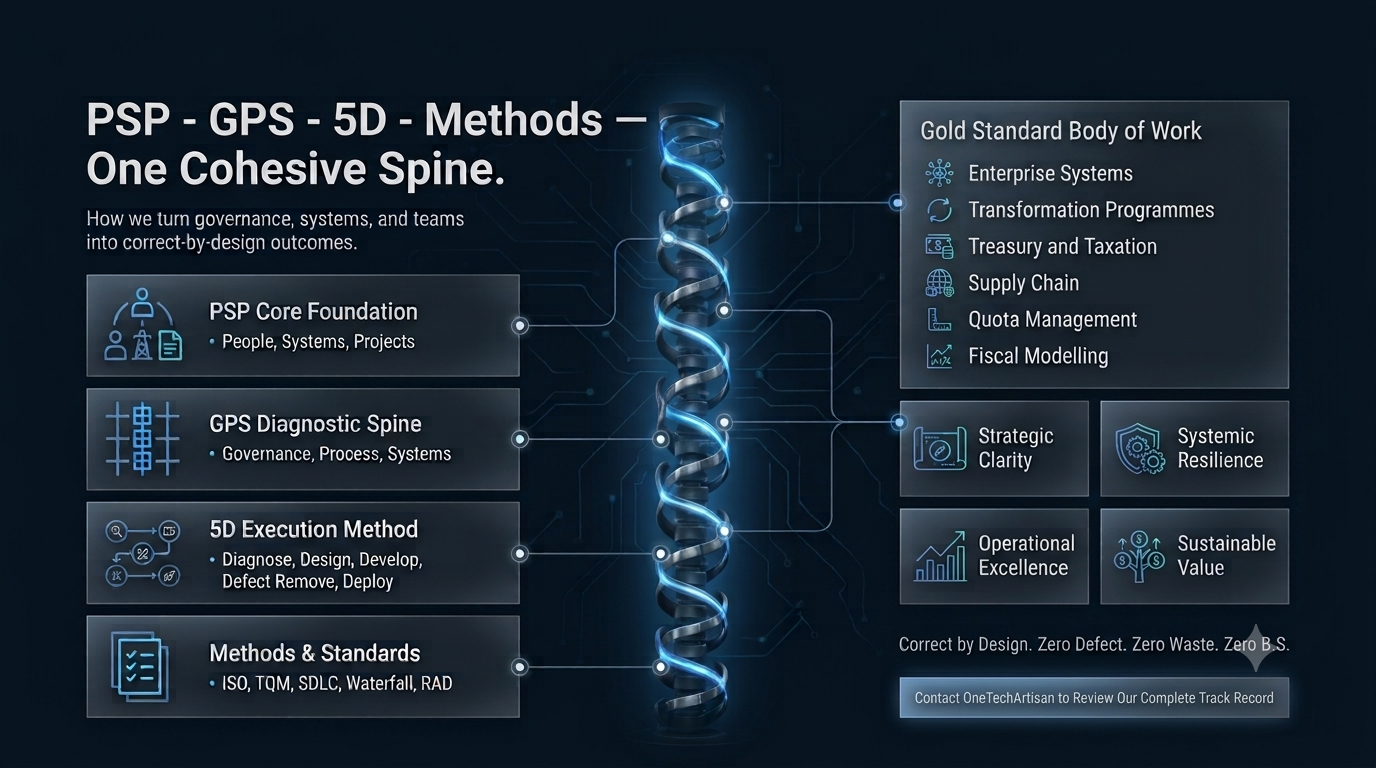
THE GPS SPINE
Three Pillars Architected for High-Stakes Systems
Governance
Governance turns rules and money into clear decision guardrails.
Proof
Long‑running national fisheries quota system still in operation after 25+ years.
Strategy, Mandate & Guardrails
Governance is where catch limits, sustainability rules, investment and board decisions are turned into clear guardrails. In a quota business, that means lining up crown legislation, regulator expectations and your own risk appetite so everyone understands who decides what, on what basis, and where the hard limits are.
I architected the functional design for a national fisheries quota management system that has run for more than 25 years as a reference point for regulators and industry.
Process
Process is the wiring between rules and daily work.
Deliverable
Repeatable, audited workflows that match quota and strategy.
Translating Strategy Into Day-to-Day Motion
Process is the wiring between the rules and the work. In practice, that’s fleet planning, procurement, production, logistics and export routines that actually match quota and market commitments, not just the monthly plan.
Lean, repeatable, audited workflows that remove bottlenecks and make the work run the way the rules and quotas say it should.
Systems
Systems are the tools that push rules and process into production.
Deliverable
Architectures where configs follow business rules.
Socio-Technical Architectures That Hold
Systems are the mix of ERP, plant control, registry and reporting tools that push governance and process into production. We design and integrate these so quota logic, sustainability rules and commercial constraints are encoded in configurations.
GOVERNED AI INTEGRATION
AI-assisted diagnostics to scan telemetry, spot silent drift, and flag gaps under strict human guardrails.
I don’t ship "AI tools" in isolation. Every simulator or telemetry engine I build sits on a designed G-P-S Diagnostic spine — legislation, mandates, capital flows and process controls first, models and automation second.
[TARGET_PROFILE_INGEST]
NODE_SERV_07
Who We Serve
Operating globally and across Australasia, focusing on high-complexity, high-stakes environments where system failure equates to material capital loss or regulatory breach.
PE-Backed Operators
We strip out technical debt that cuts your valuation.
We eliminate process friction that diminishes valuation multiples during due diligence. Ensuring exit readiness.
Agencies & Regulators
We turn legislation into working registries, not just paper.
Translating legislation and fiscal policy into functional state capacity. Functional design for national infrastructures, registries, and Treasury-level scenario simulators.
Quota-Driven Enterprises
Systems that regulators trust, teams run, and boards back.
Where quota sustainability rules collide with complex operations. We build architectures for the water and the plant.
[OPERATIONAL_HISTORY]
NODE_HIST_08
TRACK RECORD
Fixing hard problems since 1990
My niche is rapid domain adaptation, honed over more than 20,000 hours of client engagement, project execution and team development.
The pattern is simple: I land in complex environments, learn the domain fast, and help teams deliver outcomes that go past “client satisfaction” into record‑breaking performance.
I’ve worked through four major technology eras and watched the same pattern repeat: big budgets, big promises, and failure rates that regularly hit 60–70%. Every time a new hype cycle arrived, my clients got real delivery — while the wider industry stacked up stalled transformations.
The pattern I fixed, in every era, was the same — business cases built for impressive slide presenations and proposals to win approaval, but fail to deliver industry mission-critical grade production outcomes, not to mention burning millions before realising the execution did not resemble the plan.
LATEST FISCAL ARCHITECTURE
Built for fiscal authorities: simulators grounded in legislation, mandates and capital flows, not just prompts and dashboards. Recent work includes a fiscal simulation environment testing Budget‑scale scenarios built from governance rules up, not as a thin AI layer on top of spreadsheets.
THE WHY
Refusing to accept waste
The root cause of major programme failure is almost never the technology alone.
It is the earlier failure to align mandate, governance, operating process, and system design before serious capital is committed.
The Governance–Process–Systems (GPS) spine is cracked upstream, and institutions then spend years funding symptoms instead of correcting structure.
You will not find generic digital transformation, cloud, or DevOps slogans here.
The work starts with fiscal logic, governance, and architecture, and it is measured against failure rates, capital at risk, and production reality — not slideware, theatre, or recycled programme language.
I do this work because I do not accept that level of avoidable waste as normal.
My aim is simple: help a small number of organisations build systems that are correct by design, defensible under scrutiny, and strong enough to hold when policy, capital, and operations meet reality.
Zero Defect. Zero Waste. Zero B.S.
GLOBAL BRIEFING
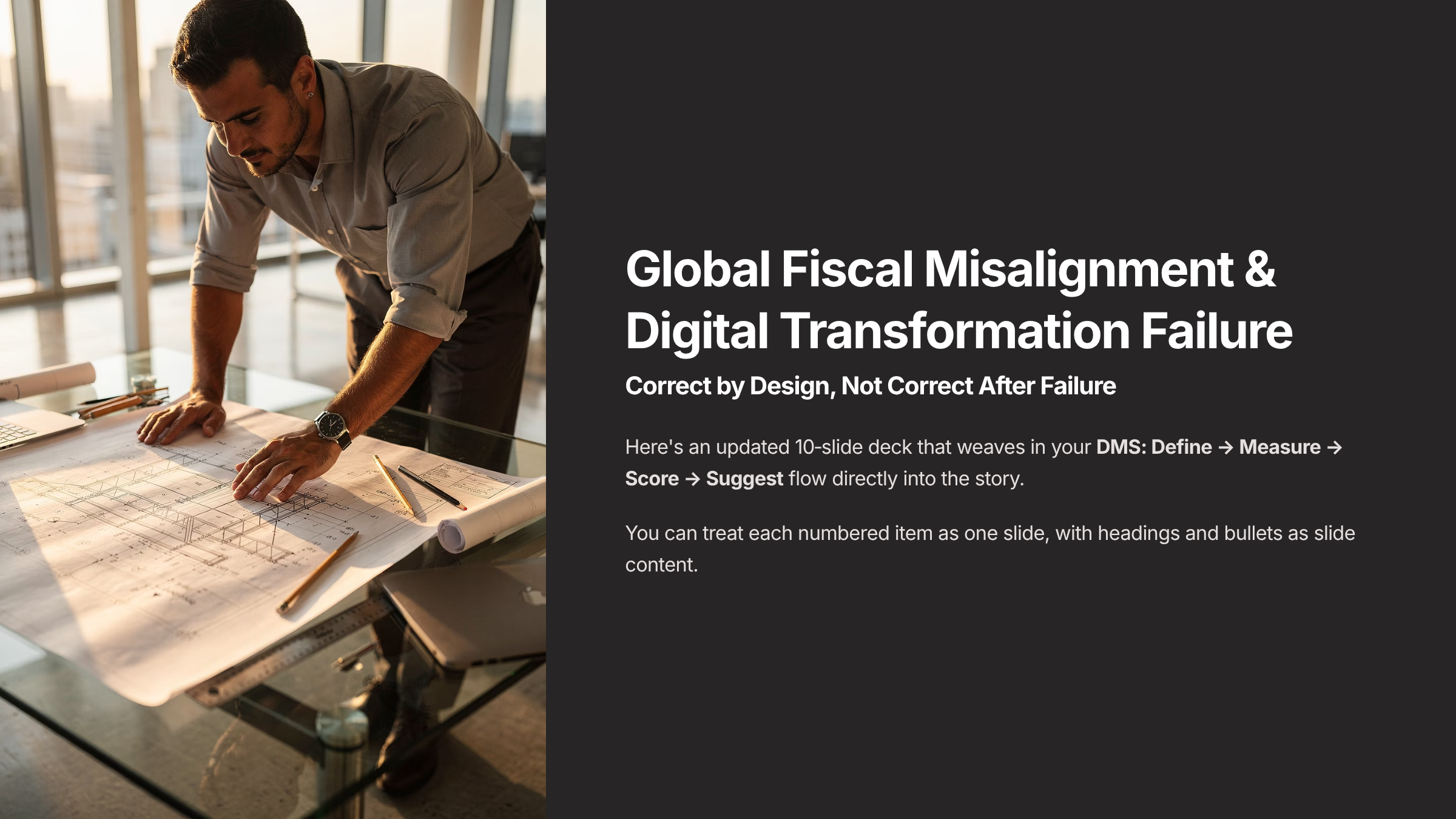
Fiscal Misalignment & Digital Failure
A 10‑part deck showing how cracked Governance–Process–Systems (GPS) pillars create fiscal chaos, and how OneTechArtisan’s DMS flow — Define, Measure, Score, Suggest — corrects it by design.
[CHAOS_METRIC_SCAN]
NODE_DIAG_05
Systemic Chaos Assessor
A fast 60‑second scan of how far reality has drifted from your governance, process and systems.
PROTOCOL: INIT_SCAN
1. How are compliance mandates / legislation linked to code & operational configurations?
ALERT: Policy drift is the primary source of unmapped operational vulnerability.
[METHODOLOGY_EXEC]
NODE_METH_06
[STRUCTURAL_TOPOLOGY]
NODE_ARCH_02
OPERATING ARCHITECTURE
This is the layered architecture I use to turn complex capital and governance problems into systems that hold.
04
Layer 04 // Roof
Methods & Standards
ISO · TQM · BPR | SDLC (Waterfall, RAD…)
Recognisable tools implemented inside the spine.
03
Layer 03 // Spine
G-P-S Diagnostic Spine
Governance · Process · Systems
Backbone linking mandates, work and platforms.
For Fiscal Authorities
For fiscal authorities and economic institutes, I don’t present a “digital transformation” story; I present a governance and architecture spine. The simulators and tools I build — including Budget‑scale fiscal environments — are designed from legislation, mandates and capital flows up, so you can see where risk and value actually move, not just where the charts look good.
02
Layer 02 // Execution
5D Execution
Diagnose · Design · Develop · Defect Remove · Deploy
Repeatable delivery cycle.
01
Layer 01 // Foundation
PSP Core Foundation
People, Systems, Projects
Human and operational fundamentals.
Figure: The OneTechArtisan architecture stack. PSP is the core foundation, 5D is the repeatable execution layer, G–P–S is the structural spine, and ISO/TQM/SDLC methods form the proof – giving boards, Treasuries and operators a single architecture for work that holds.
[OPERATIONAL_INTEL_LOAD]
NODE_TELEM_04
The PSP Core Foundation
PSP: People · Systems · Projects.
The operational foundation beneath the GPS spine: capable people, the systems that make the organisation work, and project execution disciplined enough to turn governance into real outcomes.
People
High‑performance autonomous teams
We design and run high‑performance autonomous team structures, built from 35+ years of practice. Teams own outcomes, know their guardrails, and can move fast without waiting for central command every time.
Systems
The infrastructure, not just computers
By “systems” we mean the underlying infrastructure that makes the organisation work – rules, workflows, data, platforms, and how they connect. We don’t stop at “IT”. We make sure the human and technical layers support each other, end‑to‑end.
Projects
Governance before the first line of code
Before anyone writes a line of code or runs “change management”, we establish project governance: TVR (time, value, risk), project charter, design brief, functional spec, and a clear execution roadmap. Big firms lean on generic templates; we build the frame from 40+ years of experience actually shipping projects, then customise it to your environment.
The 5-D Spine Method
We don’t run endless programmes. We stabilise the spine through a precise, five-stage loop.
01
Diagnose
Map Reality
Find where G-P-S has drifted.
02
Design
Architect Spine
Prove it holds before building.
03
Develop
Build Core
Wire rules and workflows together.
04
Defect Remove
Refine Reality
Fix issues while building.
05
Deploy
Cut Over
Go live. Watch for drift.
01 DIAGNOSE: Talk to key people, trace workflows, read systems and telemetry. Goal: see exactly where Governance, Process and Systems have drifted apart.
If we get this wrong, every later phase is built on noise.
02 DESIGN: Build small proof‑of‑concept to show the new governance, process and systems in action before committing big capital.
03 DEVELOP: Implement governance changes, new workflows and system changes together, not in silos.
04 DEFECT REMOVE: Find defects in rules, processes and systems, then loop back to refine Discovery and Design.
Runs alongside 03, constantly feeding back.
05 DEPLOY: Move the new spine into real use. Cut over teams and systems equipped with telemetry watching for drift from day one.
Phases 01–02 stabilise Governance and Process; Phases 03–05 make those decisions real in Systems.
[COMMERCIAL_ALIGNMENT]
NODE_COMM_09
Value-Based Orchestration
OneTechArtisan runs on a value‑based engagement model. We step in where most firms won’t — in environments where 60–76% of big programmes fail and “change management” is the last line of defence.
Our bet is simple: when we’re trusted to orchestrate the Governance–Process–Systems spine, we get paid for capital protected, risk removed and performance gained — not for hours on a timesheet, and not as a fixed percentage of project value. We don’t need that kind of insurance; our clients have already said, repeatedly, “just make it work.”
Outcome‑priced, not clock‑priced. We work in failure‑heavy environments and only win when your governance, process, and systems stop failing and start protecting capital.
If your capital is already at risk, the cost of not acting is already running. initiate a strategic review.